Secure Your MCP Server with Service Principal Authentication for Copilot Studio

In my previous post, we explored how to secure an MCP Server using Microsoft Entra ID delegated permissions, where the user’s identity is passed through to the API.

Secure Your MCP Server with Entra ID Authentication for Copilot Studio

But what if your scenario does not require user context?

What if you want:

  • A centralized connection
  • No per-user sign-in prompts
  • A backend service-to-service integration

In this post, we’ll walk through how to secure an MCP Server using application permissions (service principal authentication) and integrate it with Copilot Studio.

Introduction

MCP Servers exposed to Copilot Studio can be secured using different OAuth patterns:

  • Delegated permissions → user context
  • Application permissions → app-only context

This post focuses on the application permission model, where:

  • Copilot Studio uses a service principal (client credentials flow)
  • MCP Server validates app tokens instead of user tokens
  • No user interaction is required at runtime

Why Use Application Permissions?

Delegated access is great when you need user context. But in many enterprise scenarios:

  • Background operations don’t need user identity
  • Shared tools should behave consistently
  • Managing per-user connections becomes overhead

With application permissions:

  • Authentication is centralized
  • No per-user connection creation
  • Better suited for automation and shared agents

Prerequisites

Before starting:

  • Access to Microsoft Entra ID
  • Access to Copilot Studio and Power Platform
  • MCP Server implementation (you can reuse the same repo)
  • Permissions to create app registrations and custom connectors

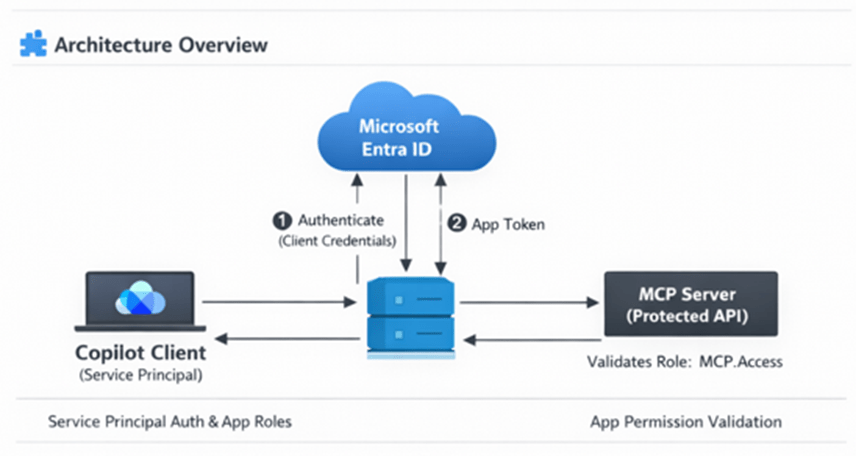
Architecture Overview

In this setup:

  • MCP Server → Protected API (App roles enabled)
  • Copilot Client → Service principal (client credentials flow)
  • Entra ID → Issues app-only tokens

Flow:

  1. Copilot (via connector) authenticates using service principal
  2. Entra ID issues app-only token
  3. Token is sent to MCP Server
  4. MCP Server validates role-based access

Step 1: Update MCP Server App Registration (Resource API)

Go to your existing MCP Server app registration created from the instructions in my other post.

Create App Roles

Navigate to App roles → Add new role:

  • Display name: Access MCP Server API
  • Allowed member types: Applications
  • Value: api.server.access
  • Description: Allows access to MCP Server as an application

This is the key difference from delegated setup.
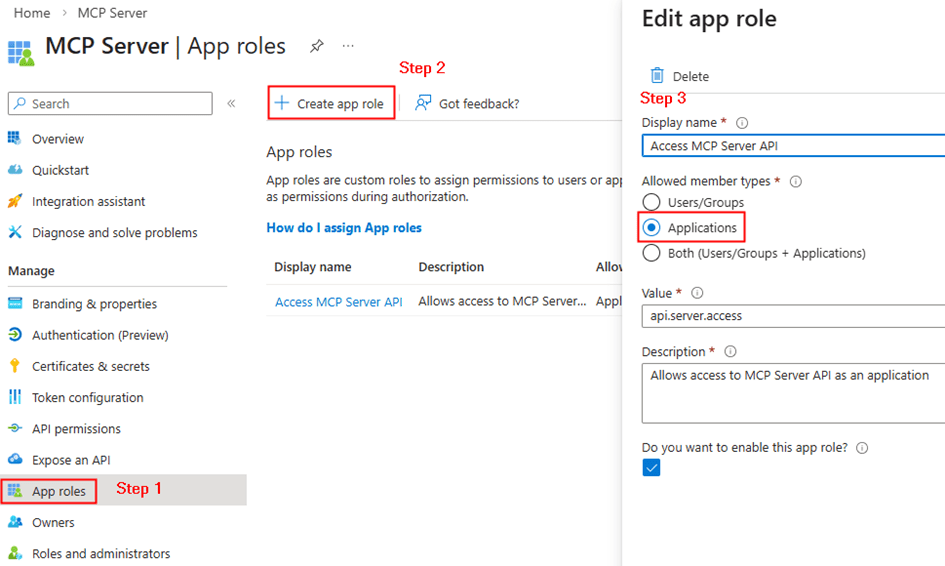
Instead of scopes, we have defined app roles for applications. Copy the resource url from the api permissions. E.g: api//xxxxx-xxxx-xxxx-xxx

Step 2: Configure Copilot Client App (Service Principal)

Go to your second app registration (Copilot client).

Add Application Permission

  • API permissions → Add permission
  • My APIs → Select MCP Server app
  • Choose Application permission → api.server.access
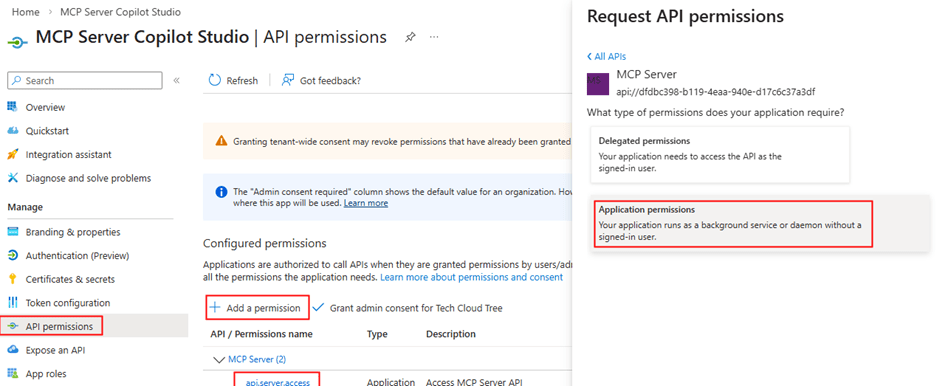
Grant Admin Consent

This allows the client app to call MCP Server without a user

Copy the client id, client secret for entering in the security tab while creating the custom connector.

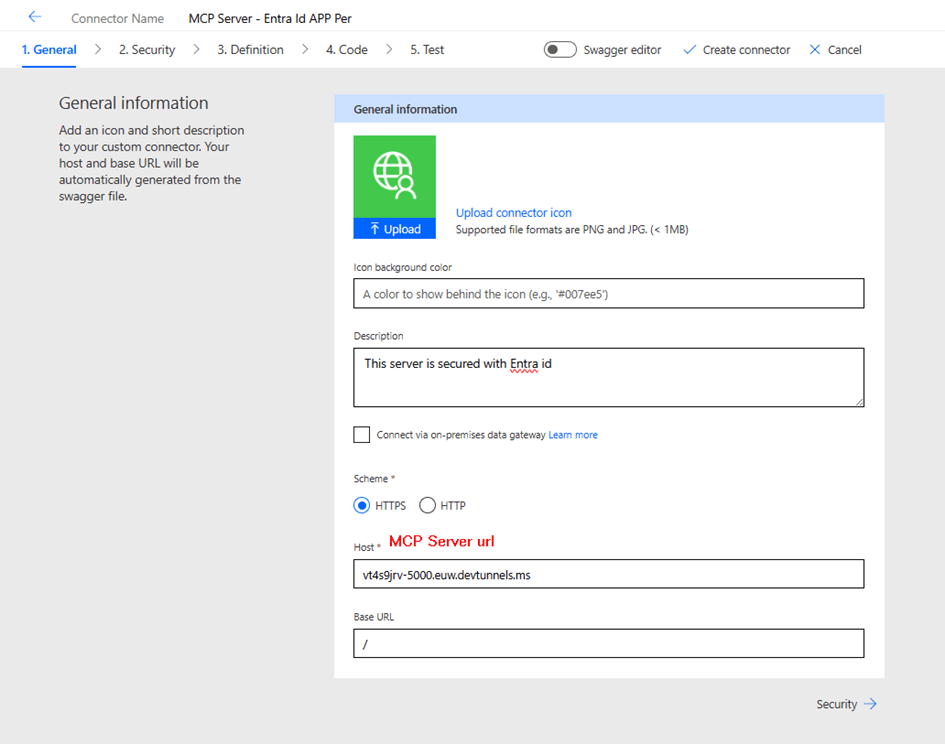
Step 3: Create Custom Connector in Power Platform

Unlike the delegated setup, this time we do not add MCP Server directly from Copilot Studio.

Instead:

  • Go to make.powerapps.com
  • Create a Custom Connector
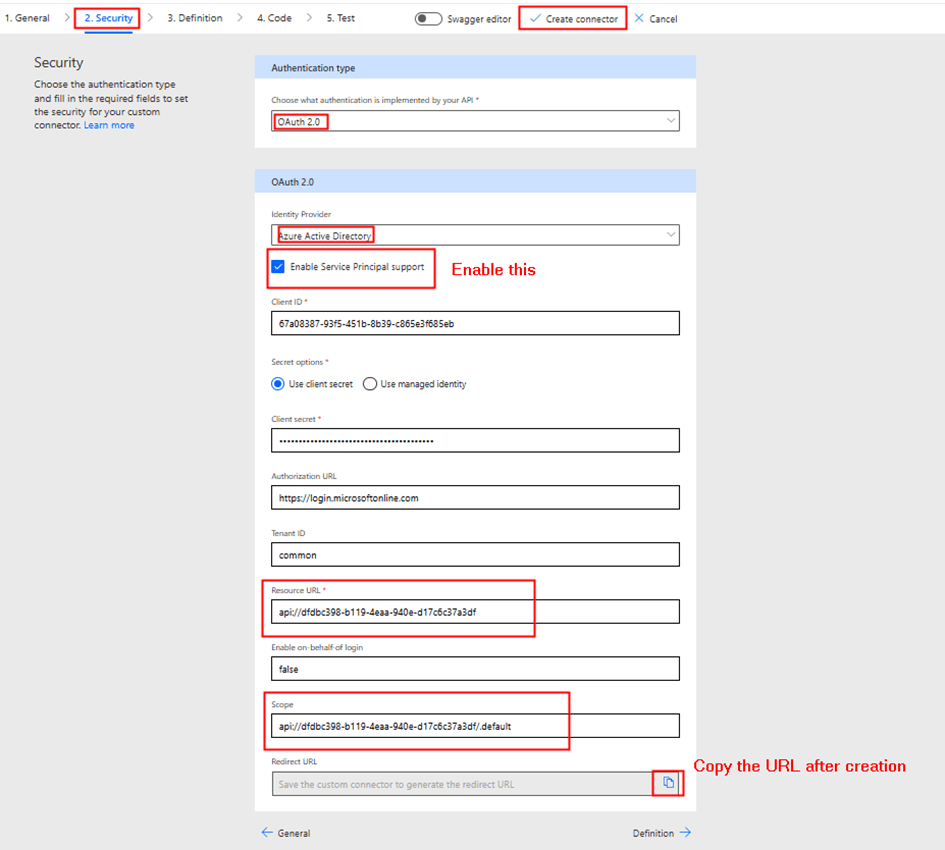
  • Configure:
    • Security → OAuth 2.0
      1. Enable Service Principal support

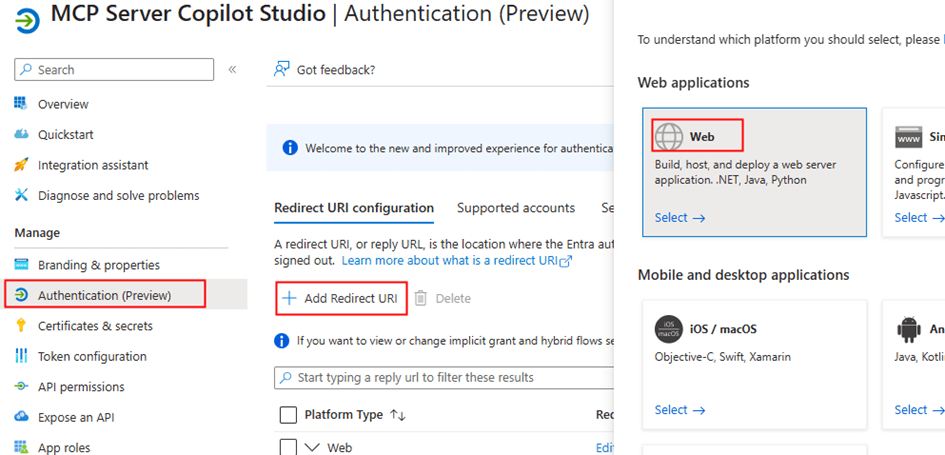
This connector uses the service principal credentials. After the entering the above details, click create connector. After the connector is created, copy the redirect URL to enter it in the Copilot studio client app registration
Now we can add the action Invoke server as below
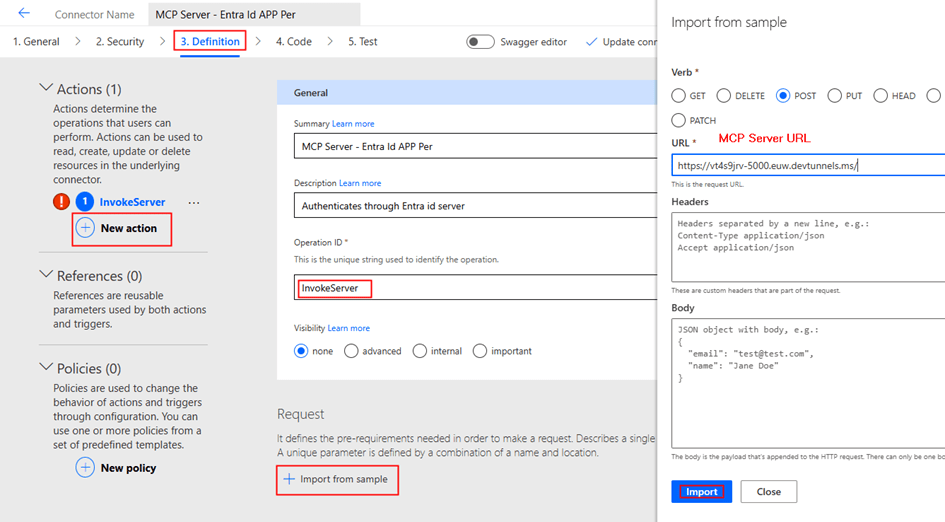
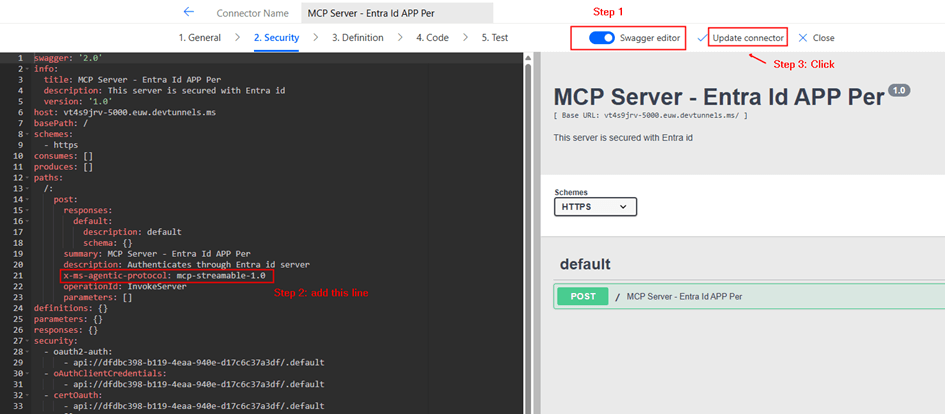
Update the connector. Now Toggle Swagger editor to add x-ms-agentic-protocol: mcp-streamable-1.0 as shown below
What It Does

Declares MCP Server Compatibility with Power Platform Agents

This extension tells Power Platform (and AI agents like Copilot) that your connector:

ComponentMeaning
x-ms-Microsoft-specific extension (not standard OpenAPI)
agentic-protocolIndicates the API supports agentic/AI agent operations
mcp-streamable-1.0Uses Model Context Protocol v1.0 with streaming support

What This Enables

  1. Agentic Discovery – Agents can discover available tools/operations
  2. Streaming Responses – Support for long-running async operations with streaming results
  3. Native MCP Integration – Direct compatibility with MCP clients and servers
  4. Agent Invocation – AI agents can invoke your MCP server endpoints intelligently

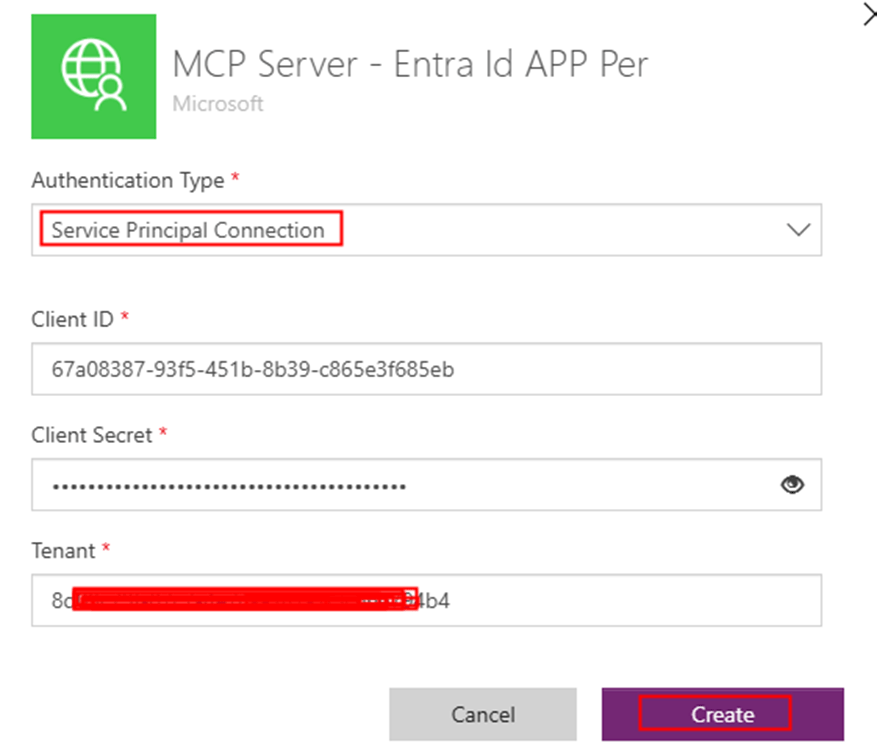
Step 4: Create Connection Using Service Principal

After updating the connector:

  • Create a new connection from the Test Tab in custom connector creation interface
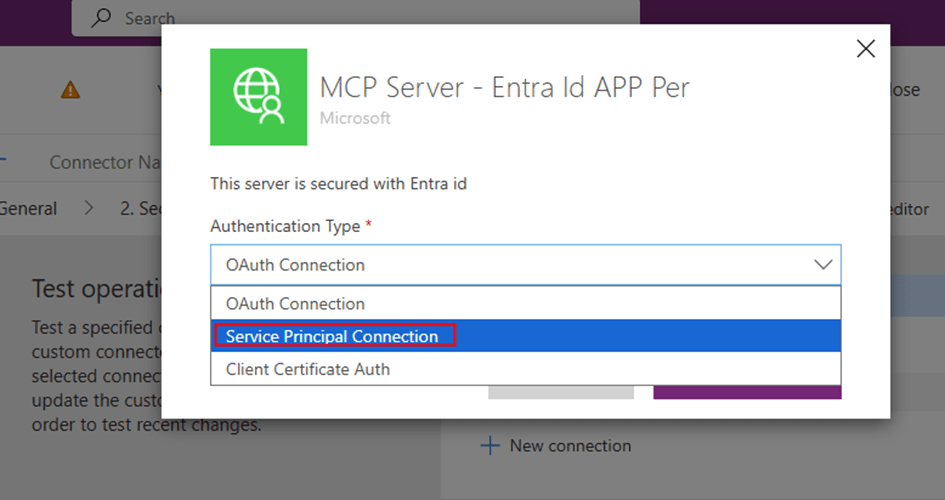
  • Provide the below from your Copilot studio client app registration:
    • Client ID
    • Client Secret
    • Tenant ID

This creates a shared connection

Key difference:

  • No user login prompt
  • Connection is tied to service principal, not individuals

Step 5: Add MCP Server to Copilot Studio

Now go to Copilot Studio:

  • Open your agent
  • Add Tool → Browse existing MCP Servers
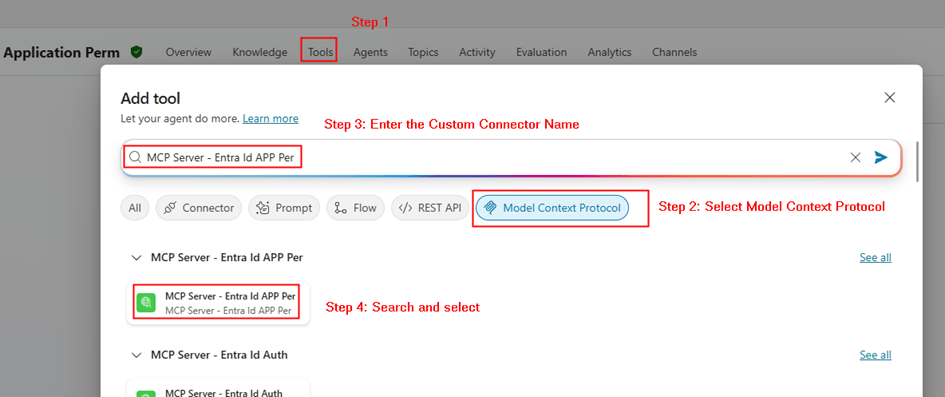
  • Select your MCP connector and the connection as below
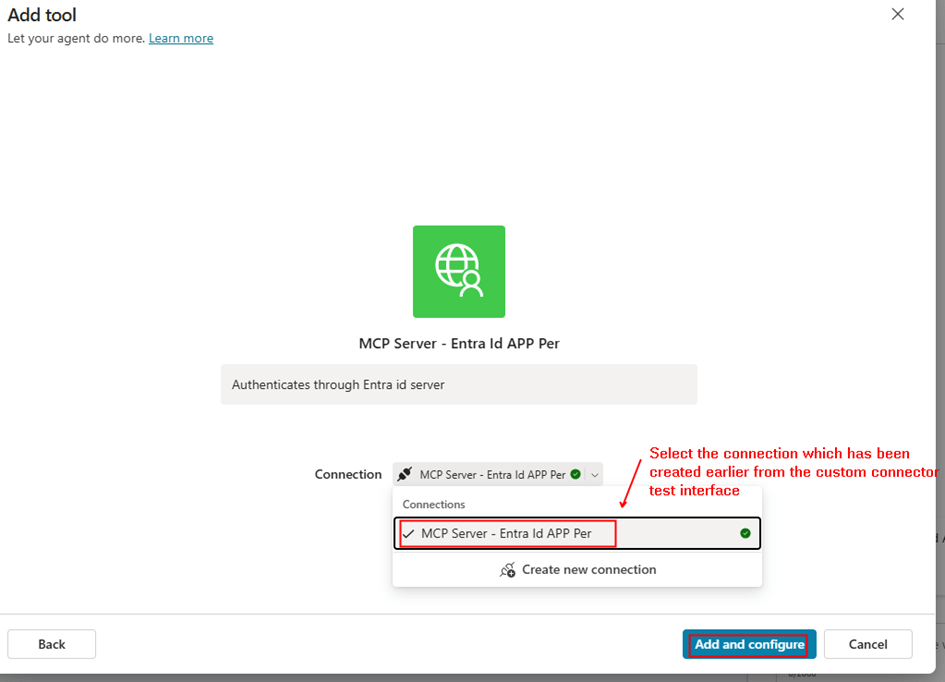
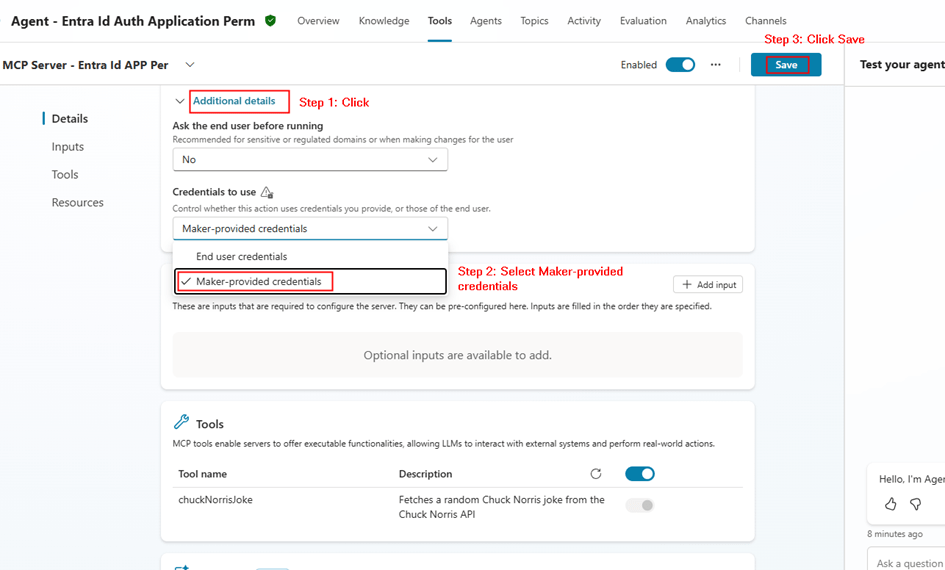
Important configuration in Copilot studio after the tool/MCP server is added:

  • Credentials to use: Maker provided
  • Save

This ensures:

  • The agent always uses the same connection
  • No per-user authentication required

Step 6: Test the MCP Agent

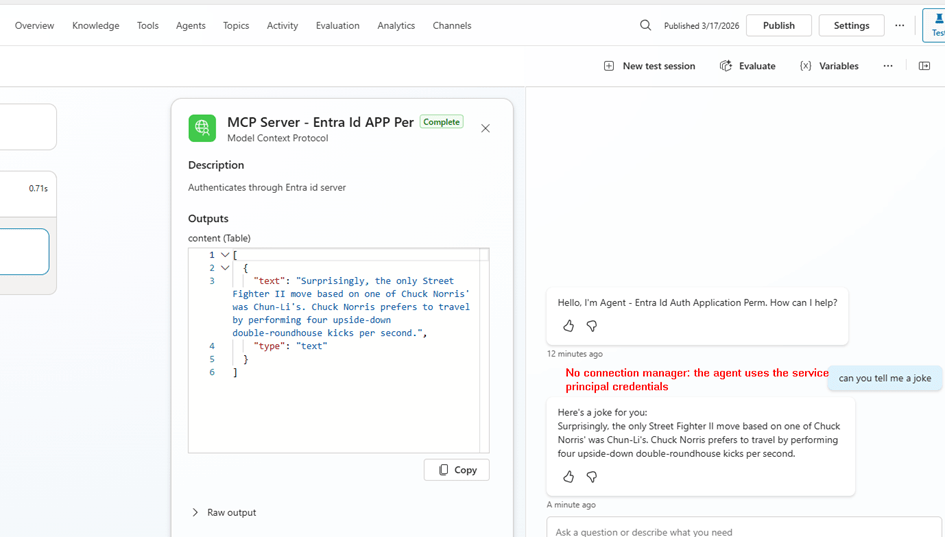
Now test your agent:

  • Invoke MCP tool
  • Verify response

You should see:

  • No login prompts
  • Consistent responses
  • Backend authentication working

Delegated vs Application Permissions

FeatureDelegatedApplication
IdentityUserApp
Token TypeUser tokenApp token
ConsentUser/AdminAdmin only
ConnectionPer userShared
Use CaseUser-specific dataBackground/shared APIs

Summary

In this post, we covered:

  • Securing MCP Server using application permissions
  • Creating app roles for application access
  • Assigning application permissions to client app
  • Creating custom connector in Power Platform
  • Using service principal connection
  • Adding MCP server to Copilot Studio via existing connector
  • Configuring maker-provided authentication

Why This Matters

Using application permissions is critical when:

  • You want centralized authentication
  • Your MCP tools don’t require user context
  • You want to avoid connection sprawl
  • You need consistent behavior across all users

This model is especially useful for:

  • Enterprise APIs
  • Shared automation tools
  • Backend integrations

Final Thoughts

Both delegated and application permission models have their place.

  • Use delegated when user identity matters
  • Use application permissions when it doesn’t

By implementing service principal authentication for your MCP Server, you enable:

  • Scalable architecture
  • Simplified connection management
  • Secure, app-driven integrations with Copilot Studio
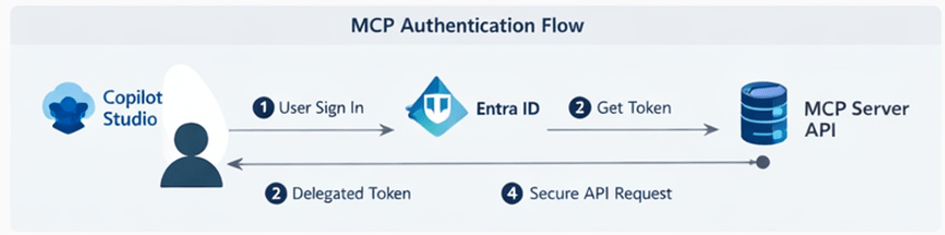
Secure Your MCP Server with Entra ID Authentication for Copilot Studio

With the rise of AI agents and extensibility through MCP (Model Context Protocol), exposing your APIs and tools to agents like Copilot Studio is becoming increasingly common. But the catch – without proper authentication, you’re opening the doors to your enterprise data.

In this post, we’ll walk through how to secure an MCP Server using Microsoft Entra ID and consume it from Copilot Studio using delegated permissions.

We’ll be using this sample repo as a reference implementation: MCP-Server-Entra-Id-Auth

Introduction

MCP servers allow AI agents to invoke tools and APIs in a standardized way. When integrated with platforms like Microsoft Copilot Studio, they unlock powerful automation scenarios.

However, MCP servers are essentially OAuth 2.0 resource servers, and every MCP client (like Copilot Studio) acts as an OAuth client.

Why Securing Your MCP Server is Important

Without proper authentication:

  • Anyone with access to the endpoint could invoke your tools
  • Sensitive operations such as internal APIs may be exposed
  • No identity context → no auditing or governance

Modern MCP implementations rely on OAuth-based authentication, ensuring:

  • Identity-aware requests
  • Scoped access tokens
  • Secure communication between client and server

In enterprise scenarios, Entra IDbecomes the natural choice.

Prerequisites

Before we begin, make sure you have:

  • Access to a Microsoft Entra ID tenant
  • Access to Microsoft Copilot Studio
  • Basic understanding of:
    • OAuth 2.0 / Delegated permissions
    • App registrations
  • MCP server up and running (use the repo above)

Architecture Overview

We will configure:

  • MCP Server → Protected resource (API)
  • Copilot Studio → Client application
  • Entra ID → Identity provider

Flow:

  1. User signs in via Copilot Studio
  2. Copilot gets delegated token
  3. Token is sent to MCP Server
  4. MCP Server validates and processes request

Step 1: Create App Registration for MCP Server (Resource API)

Go to Entra ID → App registrations → New registration

Configure:

  • Name: MCP-Server-App
  • Supported account types: Single Tenant

    After creation:

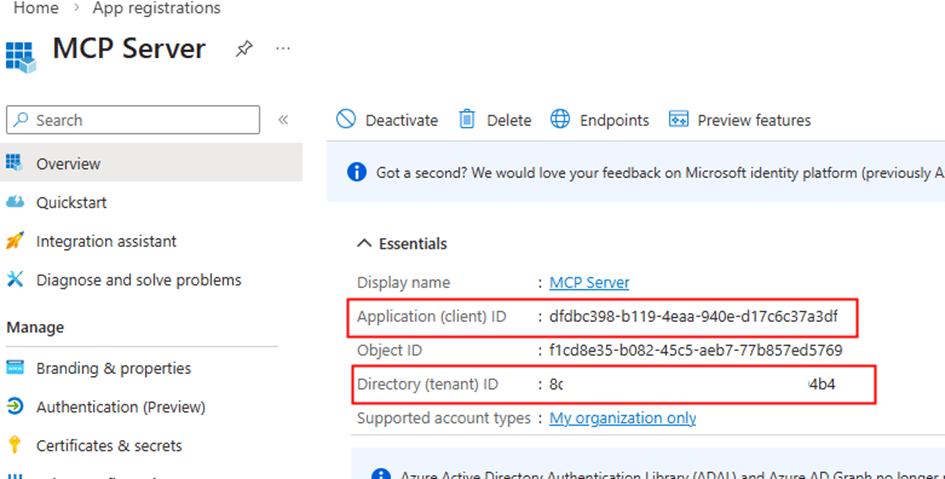
    1. Copy the Client Id, Tenant Id from the Overview section.

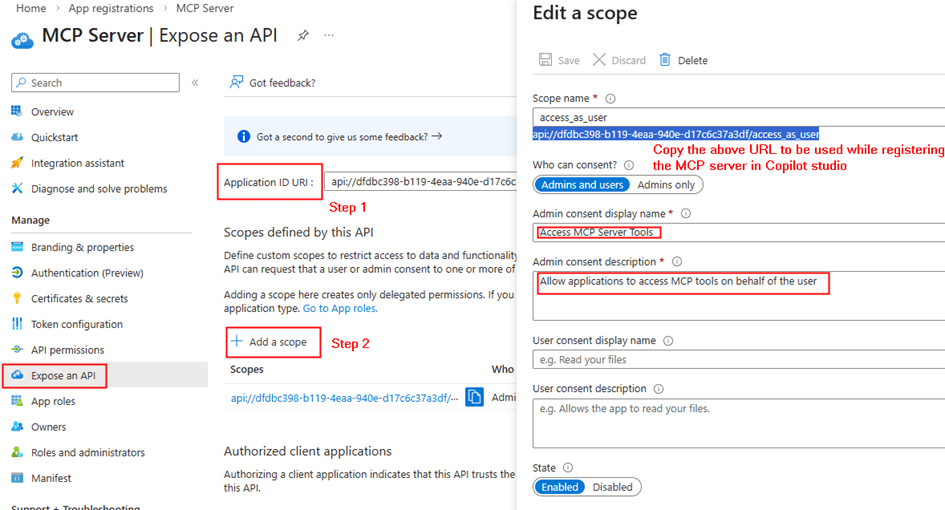
    Expose an API

    1. Go to Expose an API
    2. Set Application ID URI (e.g., api://xxx-xxxx)
    3. Add a scope:
      • Name: access_as_user
      • Who can consent: Admins + users

      Configure Permissions

      • Add required Microsoft Graph delegated permissions (if needed) or remove it.

      This app represents your secured MCP Server

      Step 2: Configure MCP Server with Entra ID

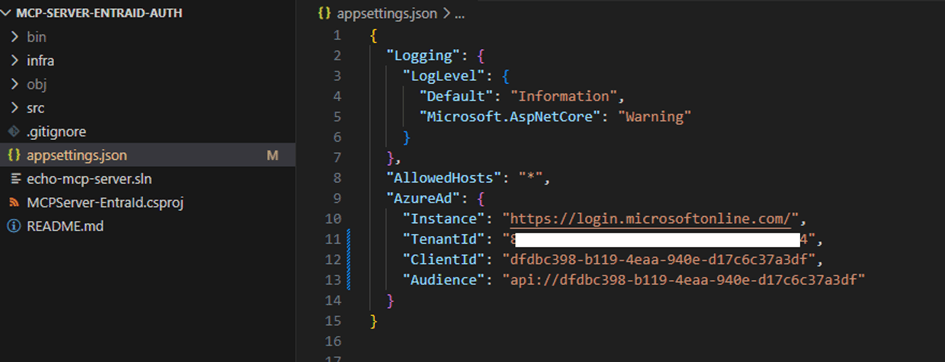
      In your MCP server, appsettings.json (from repo):

      Configure:

      • Tenant ID
      • Client ID (MCP Server app)
      • Scopes

      This allows the server to:

      • Validate incoming tokens
      • Optionally call APIs like Microsoft Graph

      Many MCP implementations use OAuth flows such as on-behalf-of (OBO)/delegates permissions to call APIs using the user’s identity.

      Step 3: Create App Registration for Copilot Studio (Client)

      Create another app:

      • Name: Copilot-MCP-Client
      • Supported Account Types: Single tenant only

      Configure:

      API Permissions

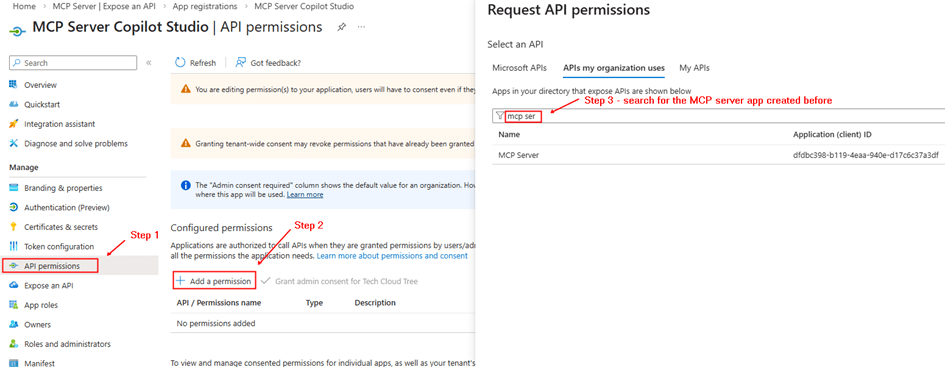
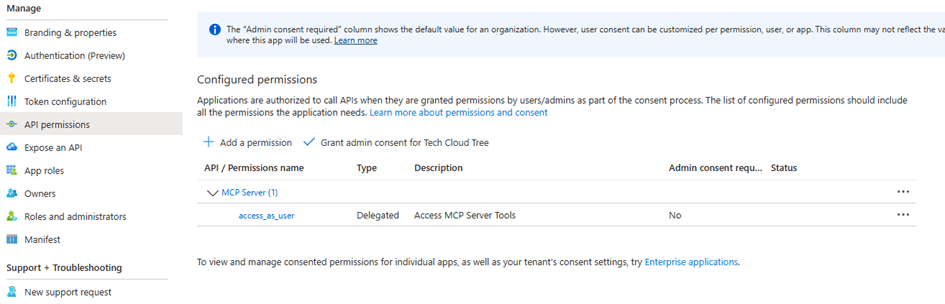
      Add permission:

      • My APIs → MCP-Server-App
      • Select: access_as_user (delegated)

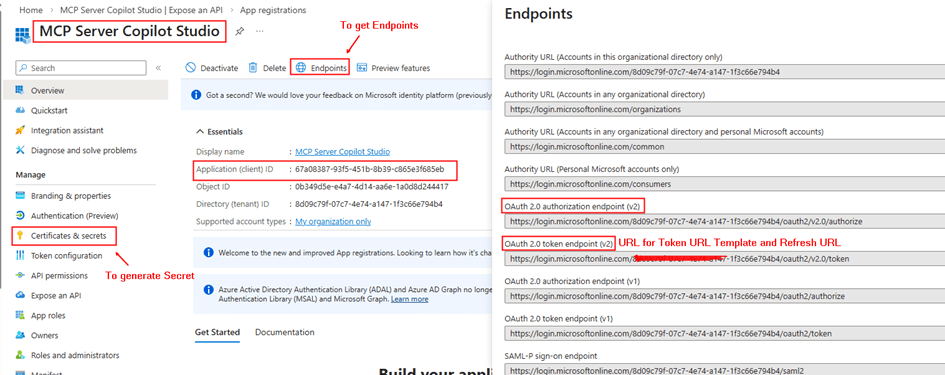
          Copy the Client Id, secret and the OAuth endpoints for adding the MCP server in Copilot studio interface.

          Grant Admin Consent

          This step is not Mandatory, if not provided an admin consent the user will asked for a consent with the permissions for the app while creating the connection to the MCP Server.

          Step 4: Add MCP Server in Copilot Studio

          Now comes the interesting part.

          In Copilot Studio:

          1. Go to Tools
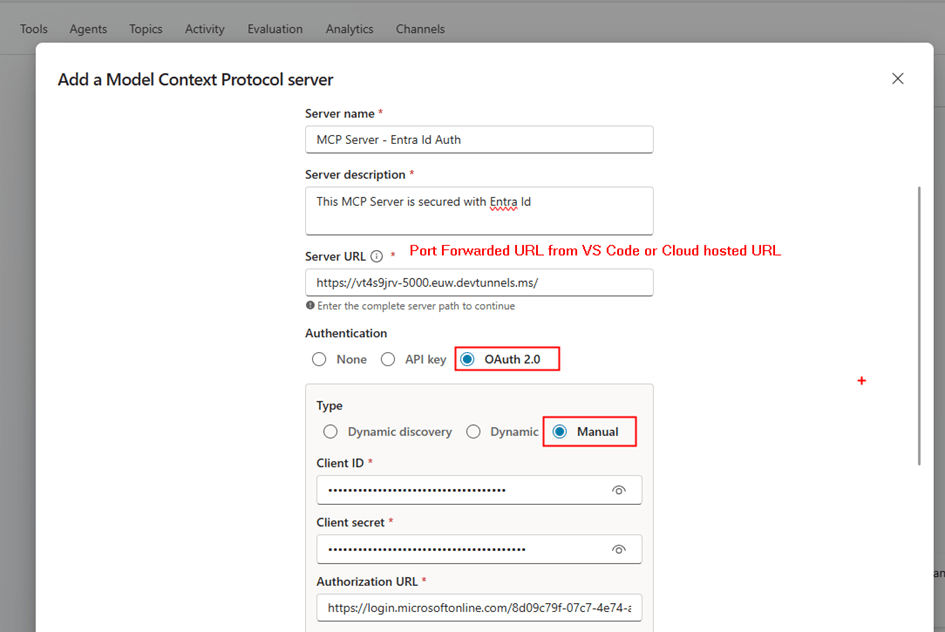
          2. Click + Add a tool > Model Context Protocol
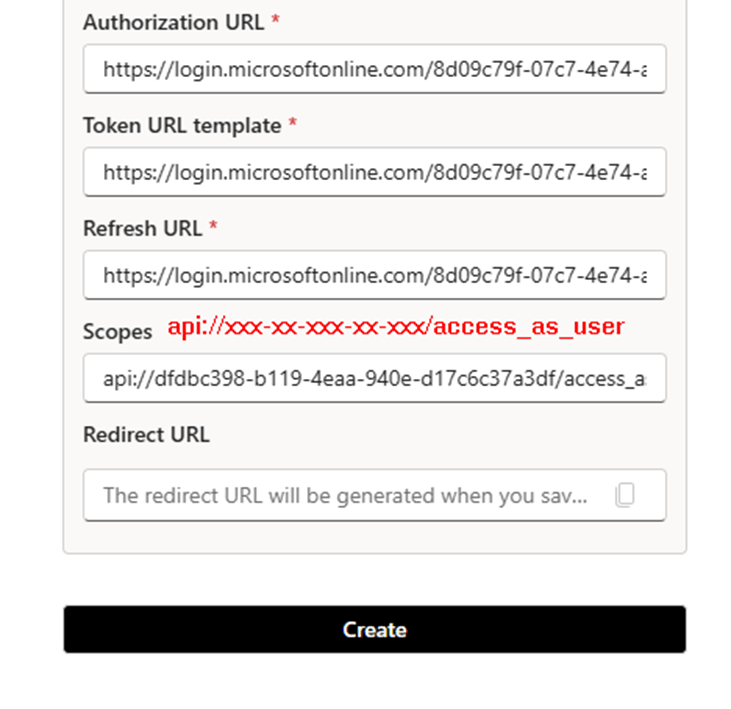
          3. Provide the details from the Copilot Studio Client app registration and MCP endpoint (e.g., /mcp or /)

          Copilot Studio will:

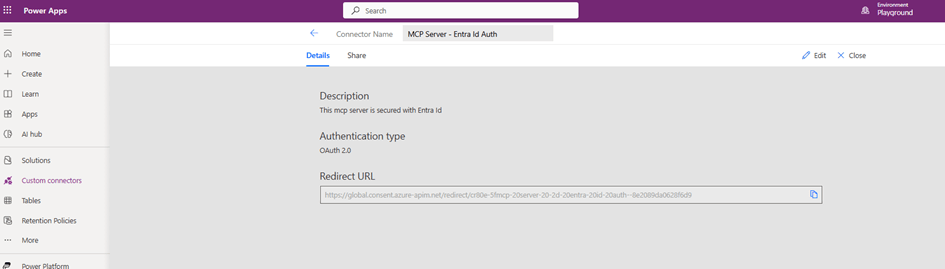
          • Create a custom connector behind the scenes

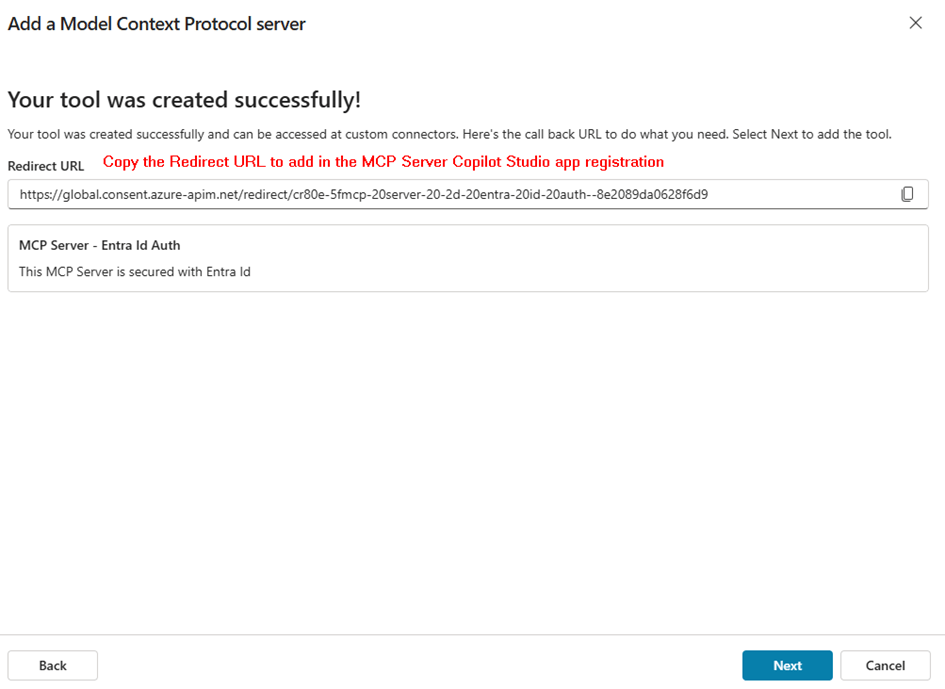
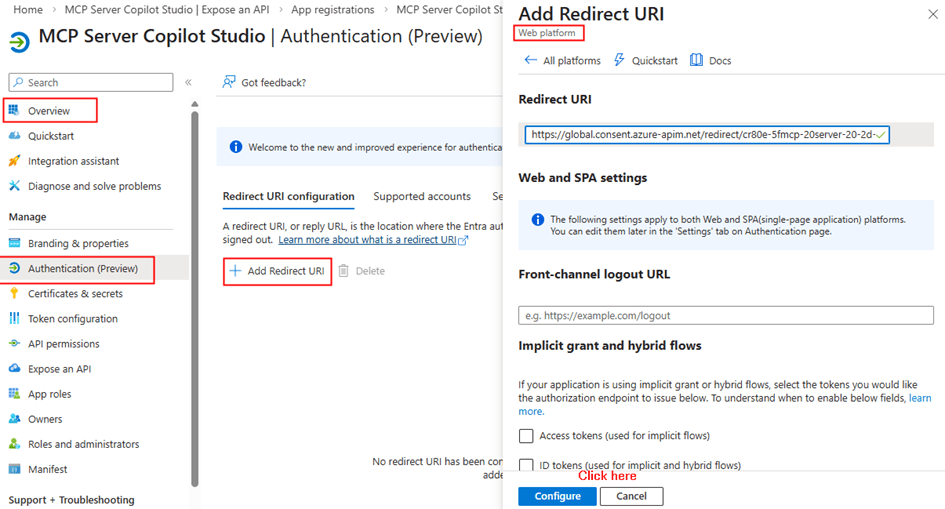
          On the next screen, you will get the link to the redirect url

          Now go to the Copilot studio client app registration Authentication section under Manage blade

          • Add Redirect URI (important for Copilot Studio custom connector)
            • Example:

          https://global.consent.azure-apim.net/redirect/xxxx

          Step 5: Create the Connection

          Once the MCP server is added:

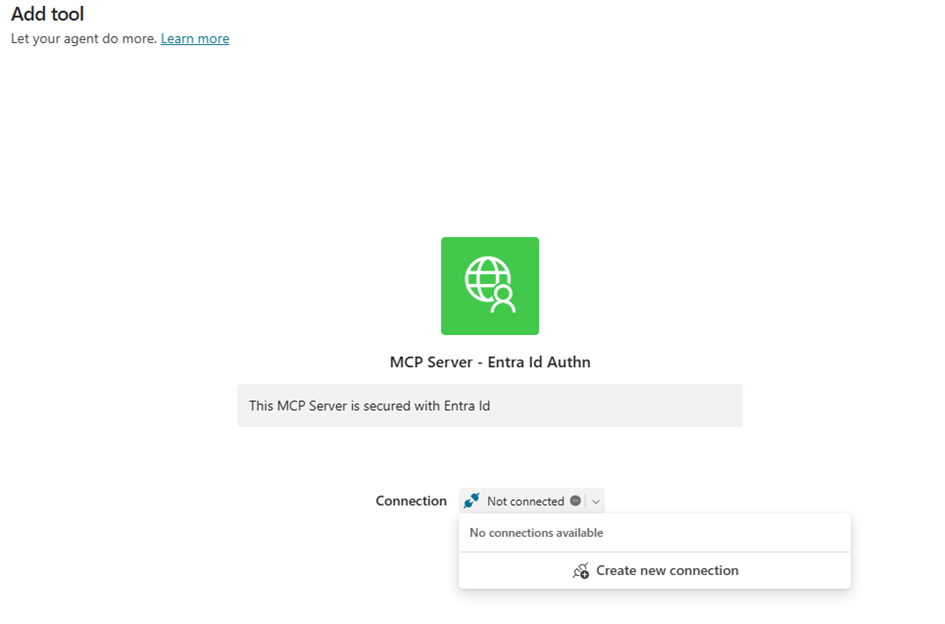
          1. Create new connection
          2. Copilot Studio prompts for authentication
          3. Sign in using Entra ID
          4. Consent to permissions

          This creates a connection instance tied to the user

          Now every MCP call:

          • Uses delegated access
          • Runs under the signed-in user context

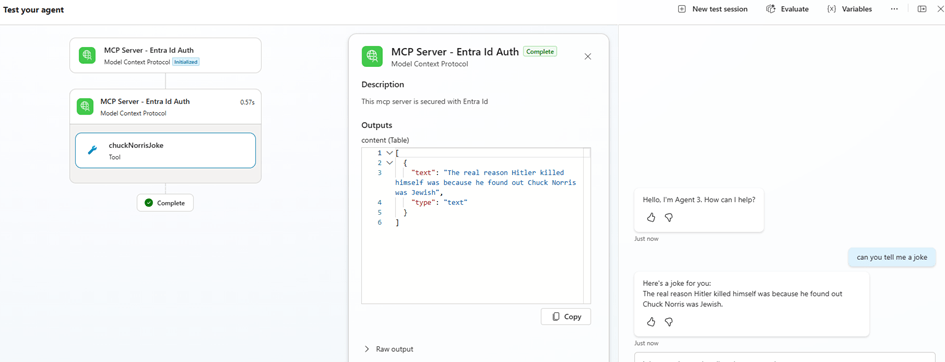
          Step 6: Test in Copilot Agent

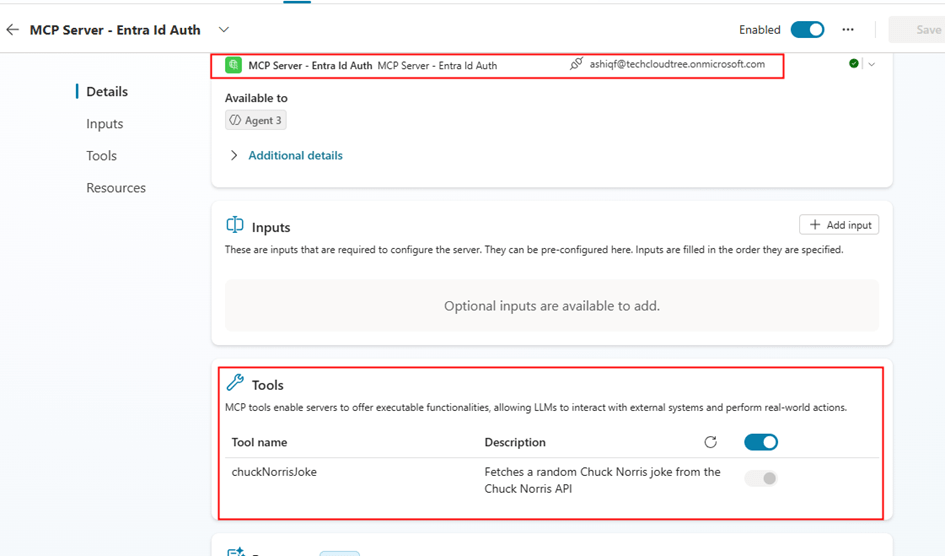
          • Add MCP tool to your agent
          • Invoke a tool (e.g., get users, groups, etc.) with a prompt
          • Verify:
            • Authentication prompt
            • Successful execution
            • User-context data

          Delegated Permissions – Why It Matters

          This setup uses delegated permissions, meaning:

          • The MCP server acts on behalf of the user
          • Access is limited to what the user is allowed to do
          • No over-permissioning (unlike app-only access)

          This is critical for:

          • Enterprise governance
          • Least privilege access
          • Auditability

          Summary:

          In this post, we covered:

          • Why MCP servers must be secured
          • How OAuth + Entra ID fits into MCP architecture
          • Creating two app registrations:
            • MCP Server (resource)
            • Copilot Studio (client)
          • Adding MCP server in Copilot Studio
          • Automatic custom connector creation
          • Using delegated permissions for secure access

          Final Thoughts

          As MCP adoption grows, security is not optional – it’s a design requirement.

          By integrating Microsoft Entra ID with your MCP server:

          • You get enterprise-grade authentication
          • Seamless integration with Copilot Studio
          • Identity-aware AI agents

          And most importantly, you stay in control of your data.

          Access  API’s in Power Platform Without Secrets Using Managed Identity in Custom Connectors

          In Power Platform, custom connectors make it easy to integrate with external APIs from Power Apps and Power Automate.

          In my earlier articles, I explained how to call APIs using custom connectors with different authentication approaches:

          While the above approach works well but it still requires client secrets or certificates to authenticate with Microsoft Entra ID.

          Managing secrets introduces challenges:

          • Secrets expire and must be rotated
          • Secure storage is required

          To address these challenges, Microsoft introduced Managed Identity authentication for custom connectors (Preview).

          With this capability, custom connectors can access APIs without storing client secrets, significantly improving security and simplifying management.

          In this article, we will explore how to configure Managed Identity authentication for a Power Platform custom connector. The approach works for any API secured with Microsoft Entra ID, and we will use Microsoft Graph as an example API.

          Why Managed Identity?

          Traditionally, Microsoft Entra Id protected APIs are accessed using:

          1. Delegated user authentication
          2. Service Principal or application user authentication

          Both require secret management.

          Managed Identity removes this requirement.

          Key advantages include:

          • No client secrets to manage
          • Reduced security risks
          • Native trust with Microsoft Entra ID

          This approach aligns with modern secretless authentication patterns widely used in Azure services.

          Authentication Architecture

          When using managed identity authentication with custom connectors, the authentication flow looks like this:

          Power Apps / Power è Custom Connector (Managed Identity Authentication) è Microsoft Entra ID
          (Federated Credential Trust) è Target API (e.g., Microsoft Graph)

          Instead of storing credentials, the connector uses federated identity trust to obtain access tokens from Microsoft Entra ID.

          Step 1: Register an Application in Microsoft Entra ID

          First, create an App Registration in Microsoft Entra ID.

          Navigate to:

          Azure Portal → Microsoft Entra ID → App registrations → New registration

          Supported account types:
          Single tenant

          After creating the app, note the following values:

          • Application (Client) ID
          • Tenant ID

          Managed identity authentication currently supports single-tenant applications.

          Step 2: Configure API Permissions

          Add the required permissions depending on the API you are accessing.

          Since we are using Microsoft Graph as an example, we have left it with the default delegated permission:

          • User.Read

          Grant Admin Consent if required depending on the permissions you have added.

          Step 3: Create a Custom Connector

          Navigate to the Power Apps or Power Automate Maker Portal.

          Create a new connector:

          Custom Connectors → New Custom Connector → Create from Blank

          Provide a connector name such as:

          Managed Identity API Connector

          In the General tab configure the API host.

          Example for Microsoft Graph:

          Host: graph.microsoft.com

          Base URL: /

          If you are connecting to another API, replace these values with that API’s endpoint.

          Step 4: Configure Managed Identity Authentication

          In the Security tab.

          Authentication Type: OAuth 2.0

          Identity Provider: Azure Active Directory

          Provide:

          Client ID → Application ID of your App Registration

          Secret Options → Managed Identity (Preview)

          Authorizations URL → https://login.microsoftonline.com

          Tenant ID → Your tenant GUID

          Resource URL → https://graph.microsoft.com/

          Scope → User.Read

          Click Create connector.

          After the connector is created, Power Platform generates two important values:

          • Redirect URL
          • Managed Identity

          These represent the identity of the connector.

          Step 5: Configure Federated Credentials

          Open the App Registration in Microsoft Entra ID. Add the Redirect url copied from the custom connector

          Then Navigate to:

          Certificates & Secrets → Federated Credentials

          Add a new credential.

          Choose: Other issuer

          Provide the values generated from the connector:

          Issuer → Issuer value from connector

          Type → Explicit subject identifier
          Subject → Subject identifier from connector

          Credentials Details:

          Name & Description: Any name representing your connector

          Federated Identity Credentials (Sample):

          Issuer: https://login.microsoftonline.com/xxxxx-yourtenand-id-xxxxxx/v2.0
          Subject: /eid1/c/pub/t/xxxxxxx/a/xxxxxx/unitedstates-002_ms-20graph-20-2d-20no-20secret-5f820e575d611694-e6ed89f31466204d
          Audience: api://AzureADTokenExchange

          This configuration establishes trust between the custom connector and the Entra ID application.

          Once this trust is established, the connector can request access tokens without using a client secret.

          Step 6: Define API Actions

          Now define actions in the Definition tab of the custom connector.

          For the Microsoft Graph example, we will create an action to retrieve the current user profile.

          HTTP Method: GET

          URL: https://graph.microsoft.com/v1.0/me

          You can define additional actions depending on the API endpoints you want to expose.

          For other APIs, configure the corresponding endpoints.

          Step 7: Create the Connection

          Navigate to the Test tab and create a new connection.

          Unlike service principal authentication, you do not need to provide client secrets.

          Power Platform will automatically authenticate using the managed identity configuration.

          Step 8: Use the Connector

          The connector can now be used from:

          • Power Apps
          • Power Automate

          Benefits of Managed Identity for Custom Connectors

          Using managed identity authentication provides several advantages:

          Improved Security

          No client secrets or certificates are stored in Power Platform.

          Reduced Operational Overhead

          No secret rotation or credential management.

          Current Limitations

          This capability is currently in preview

          Summary:

          Managed Identity authentication for Power Platform custom connectors enables secure, secretless access to APIs. Although we used Microsoft Graph as the example, the same pattern can be applied to any API secured with Microsoft Entra ID.

          This approach simplifies security management and provides a cleaner architecture for enterprise Power Platform integrations.

          Unlocking Snowflake Data Integration in Power Platform: Out of the box Snowflake connector – Part 3

          In both Part 1 and Part 2 of this blog series, we explored integration techniques using the Snowflake REST API through a custom connector. There is a Snowflake connector in Preview for an extended period, featuring actions for submitting, monitoring status, and cancelling SQL statements. In this post, we’ll delve into how you can leverage this connector within a Power Automate flow to execute a SQL statement

          There is a prerequisite to be done within the Snowflake environment by executing the following SQL script to make modifications to the security integration created in the Part 1 of the blog series.

          ALTER SECURITY INTEGRATION connector
          SET EXTERNAL_OAUTH_AUDIENCE_LIST = ('https://analysis.windows.net/powerbi/connector/snowflake', 'api://8a3865da-e301-46c6-801f-7417a75a8271');

          The OOB Snowflake connector uses Power BI Analysis service API.

          Enter the necessary details related to the Snowflake instance you intend to connect to and the SQL statement you aim to execute, you are prepared to test the connector.

          The Select action is make the data transformation.

          Reference:

          https://learn.microsoft.com/en-us/connectors/snowflakeip

          https://www.snowflake.com/blog/microsoft-power-platform-connector

          Summary:

          Hope you have found this informational & thanks for reading. If you are visiting my blog for the first time, please do look at my other blogposts.

          Do you like this article?

          Subscribe to my blog with your email address using the widget on the right side or on the bottom of this page to have new articles sent directly to your inbox the moment I publish them.

          Unlocking Snowflake Data Integration in Power Platform: Manipulating Snowflake REST API response in Custom Connector – Part 2

          In Part 1 of the blog series, we covered the setup and configuration necessary for Snowflake integration using the Snowflake REST API with a custom connector. The API response isn’t directly usable in Power Apps if the action is directly called within Power Apps instead of Power Automate flow leveraging Data operations (Select) connector. In this blog post, let’s explore how to manipulate the Snowflake API response using custom code with C# to transform the response payload. Find below the response from the API, without transformation, appears as follows for the SQL statement select name, age from rockers_table.

          {
            "resultSetMetaData": {
              "numRows": 10,
              "format": "jsonv2",
              "partitionInfo": [
                {
                  "rowCount": 10,
                  "uncompressedSize": 243
                }
              ]
            },
            "data": [
              [
                "Mohamed Ashiq",
                "27"
              ]
            ],
            "code": "090001",
            ....
          }

          Update Custom Connector:

          Revise the custom connector created in the previous blog post by clicking “Code” to add the C# code for transforming the data. The required response to the SQL query is under the key named data, and the value before and after transformation, is shown below.

          Before ManipulationAfter Manipulation
          “data”: [     [       “Mohamed Ashiq”,       “27”     ]   ]  “data”: [     {       “Name”:”Mohamed Ashiq”,       “Age”:”27″     }   ]  

          The following C# code transforms the response in the required format:

          public class script: ScriptBase
          {
          public override async Task < HttpResponseMessage > ExecuteAsync()
          {
              // Check which operation ID was used
              if (this.Context.OperationId == "GETSFData") 
              {
                  return await this.ManipulateResponse().ConfigureAwait(false);
              }
          
              // Handle an invalid operation ID
              HttpResponseMessage response = new HttpResponseMessage(
                  HttpStatusCode.BadRequest
              );
              response.Content = CreateJsonContent(
                  $"Unknown operation ID '{this.Context.OperationId}'"
              );
              return response;
          }
          
          private async Task < HttpResponseMessage > ManipulateResponse()
          {
              // Use the context to forward/send an HTTP request
              HttpResponseMessage response = await this.Context.SendAsync(
                  this.Context.Request,
                  this.CancellationToken
              ).ConfigureAwait(continueOnCapturedContext: false);
          
              // Do the transformation if the response was successful
              if (response.IsSuccessStatusCode)
              {
                  var responseString = await response.Content.ReadAsStringAsync().ConfigureAwait(
                  continueOnCapturedContext: false
                  );
           
                  // Example case: response string is some JSON object
                  var result = JObject.Parse(responseString); 
          
                  // Initialize an empty array to store the new formatted data
                  var newDataArray = new JArray();
          
                  // Iterate over the original "data" array
                  foreach (var item in result["data"])
                  {
                      // Create a new JObject for each inner array
                      var newItem = new JObject
                      {
                          ["Name"] = item[0], // Set the "Name" property
                          ["Age"] = item[1]   // Set the "Age" property
                      };
          
                      // Add the new JObject to the new data array
                      newDataArray.Add(newItem);
                  }
          
                  // Create a new JObject to hold the formatted data
                  var newResult = new JObject
                  {
                      ["data"] = newDataArray // Set the "data" property to the new formatted data array
                  };
          
                  response.Content = CreateJsonContent(newResult.ToString());
              }
               return response;
          }
          }

          In the Power Apps, the PowerFX to execute the SQL query is

          Set(sfData, 'CC-SnowFlake-AWS'.GETSFData({database: "HOL_DB",role:"PUBLIC",schema:"PUBLIC",statement:"select name, age from rockers_table;",warehouse:"HOL_WH"}))

          To display the value in the gallery control, the Power FX is sfData.data

          Reference:

          https://learn.microsoft.com/en-us/connectors/custom-connectors/write-code

          https://learn.microsoft.com/en-us/connectors/custom-connectors/policy-templates/convertarraytoobject/convertarraytoobject

          Summary:

          The scenario provided above serves as just one example of data transformation. While Power Automate offers data operations that can assist in such tasks, the method described above facilitates using the connector action directly within Power Apps. Hope you have found this informational & thanks for reading. If you are visiting my blog for the first time, please do look at my other blogposts.

          Do you like this article?

          Subscribe to my blog with your email address using the widget on the right side or on the bottom of this page to have new articles sent directly to your inbox the moment I publish them.

          Unlocking Snowflake Data Integration in Power Platform: Using Custom Connector with Snowflake REST API – Part 1

          In today’s data-driven world, businesses rely on integration between their data sources and analysis platforms to derive insights and make informed decisions. One such powerful combination is leveraging Snowflake, a leading cloud-based data warehousing platform, alongside Microsoft Power Platform. In this blog series, we’ll delve into the options of integrating Snowflake data sources into Power Platform, exploring both custom and out-of-the-box connector options. In Part 1, our focus will be on setting up and configuring Snowflake, followed by creating a custom connector that leverages Snowflake’s SQL REST API. This connector facilitates the connection between Snowflake and the Power Platform services such Power Apps and Power Automate.

          Pre-requisites:

          • Snowflake account with Account Admin access: Snowflake offers a 30-day trial, granting full access to explore its capabilities. You can select either Azure/AWS/GCP
          • Entra ID access (Global Admin or Privileged Administrator Role) to create App registration and grant Admin consent: Ensure you have Entra ID access to enable the creation of App registrations and to grant Admin consent for necessary permissions.
          • Power Platform Administrator Role: To make adjustments to allow custom connector endpoints for Snowflake identifier URL, especially in cases where endpoints are blocked by the tenant scoped DLP policy.
          • Maker or System Administrator access in a Power Platform Environment: Access privileges should include Maker or System Administrator rights within your Power Platform environment to register custom connector.
          • Power Apps premium license: A Power Apps premium license is required to use a custom connectors in a Power Apps or a Cloud flow.

          This blog post is divided into the following sections:

          • Creation of Entra ID Apps.
          • Setup Snowflake Environment.
          • Creation of a custom connector & DLP Policy Update.

          Creation of Entra ID Apps:

          There are two app registrations required to facilitate the API access through Microsoft Entra ID, where one would represent the Snowflake OAuth resource and the other would represent the OAuth client application which would be in this case the custom connector

          Section 1 – Registering an Application in Microsoft Entra ID for Snowflake OAuth resource:

          In the Entra ID portal, navigate to App registrations and click + New registration. Enter a name, such as Snowflake OAuth resource, and proceed by clicking the Register button, leaving all settings as default.

          Under the Manage section in the side menu, select Expose an API. Set the Application ID URI with the default value and remember to copy this value for future use. This will be known as external_oauth_audience_list in the section Setup and configuration in Snowflake

          Click on the Add a scope button to access the panel. The Snowflake Role Public is added as an OAuth scope for OAuth flows where the Snowflake OAuth client acts on behalf of a user from the custom connector. If there is a custom Snowflake role, it should be added as a scope instead of ‘Public’:

          1. Enter a new Scope name as session:scope:PUBLIC
          2. Set Admin consent display name to Account Admin
          3. Provide Admin consent description as “Can Administer the Snowflake account”
          4. Ensure the Enabled scope state is selected.

          Complete the process by selecting the Add scope button to create the scope.

          Section 2 – Registering an Application in Microsoft Entra ID for Snowflake OAuth client:

          In the Entra ID portal, navigate to App registrations and click + New registration. Enter a name, such as Snowflake OAuth client, and proceed by clicking the Register button, leaving all settings as default.

          Retrieve the Client ID, Tenant Id from the Overview section of the Entra ID app and generate a secret through the Certificates & secrets under the Manage blade. Once the secret is successfully created, copy its value for use in configuring the custom connector OAuth Authentication.

          In the API permissions section under the Manage blade, click + Add a permission and search for Snowflake OAuth resource, the application created previously.

          Select the Delegated permission session:scope:PUBLIC defined in the previous section as shown below, and grant Admin consent.

          Everything is configured in Entra ID. Now, let’s move on to Snowflake to set up the necessary components for this integration to function.

          Reference: https://docs.snowflake.com/en/user-guide/oauth-azure

          Setup Snowflake Environment:

          Let’s head in to the Snowflake instance as an Account Admin. Here, you’ll create a

          • Create Database with sample data & grant roles
          • Set up security integration
          • Create a user in Snowflake synchronized with the Entra ID user

          Log in to the Snowflake instance to copy the Identifier URL as shown below. This URL will be used in the custom connector to access the Snowflake REST API.

          Snowflake Identifier URL: https://texxxx.eu-north-1.aws.snowflakecomputing.com

          Create Database with sample data & grant role:

          Create a SQL Worksheet as shown below and execute the following script to set up the Snowflake environment by creating a warehouse, database, and table named ‘rockers_table’. Sample data is inserted into the table, and permissions are granted to the ‘public’ role for accessing and updating the table:

          -- Switch to the 'accountadmin' role
          use role accountadmin;
          -- Create the HOL_WH warehouse with size 'X-SMALL'
          CREATE OR REPLACE WAREHOUSE HOL_WH WITH WAREHOUSE_SIZE='X-SMALL';
          -- Create the HOL_DB database
          CREATE OR REPLACE DATABASE HOL_DB;
          -- Grant usage on the warehouse HOL_WH to the role 'public'
          GRANT USAGE ON WAREHOUSE hol_wh TO ROLE public;
          -- Grant usage on the database HOL_DB to the role 'public'
          grant usage on database hol_db to role public;
          -- Grant usage on the schema HOL_DB.PUBLIC to the role 'public'
          grant usage on schema hol_db.public to role public;
          use role accountadmin;
          -- Switch to the HOL_DB database
          use database HOL_DB;
          use warehouse HOL_WH;
          -- Create the 'rockers_table' table
          CREATE TABLE rockers_table (
            id INT,
            name VARCHAR(50),
            age INT
          );
          -- Insert data into the 'rockers_table' table
          INSERT INTO rockers_table (id, name, age)
          VALUES (1, 'Jimi Hendrix', 27),
                 (2, 'Janis Joplin', 27),
                 (3, 'Elvis Presley', 42),
                 (4, 'Freddie Mercury', 45),
                 (5, 'Whitney Houston', 48),
                 (6, 'Michael Jackson', 50),
                 (10, 'John Lennon', 40);
          -- Grant select and update permissions on the 'rockers_table' table to the role 'public'
          grant select, update on table hol_db.public.rockers_table to role public;

          Set up security integration:

          Let’s proceed to create the Security integration, which is a Snowflake object that establishes an interface between Snowflake and Entra ID. This integration is a prerequisite for enabling Entra OAuth authentication in the custom connector. Execute the following script:

          create security integration connector
                 type = external_oauth
                 enabled = true
                 external_oauth_type = azure
                 external_oauth_issuer = 'https://sts.windows.net/tenantId/'     
                 external_oauth_jws_keys_url = 'https://login.microsoftonline.com/tenantId /discovery/v2.0/keys'
                 external_oauth_audience_list = ('applicationIDURI')
                 external_oauth_token_user_mapping_claim = 'upn'
                 external_oauth_snowflake_user_mapping_attribute = 'login_name'
                 external_oauth_any_role_mode = 'ENABLE';

          Replace the tenantid in ‘external_oauth_issuer’ and ‘external_oauth_jws_keys_url’, and the Application ID URI in ‘external_oauth_audience_list’. These values should be copied from sections 1 and 2 of the Entra ID app creation process written above.

          Reference:

          https://quickstarts.snowflake.com/guide/power_apps_snowflake/#0

          Create a user in Snowflake synchronized with the Entra ID user:

          We’ll create a user in Snowflake that mirrors the Entra ID user upn as created in the security integration. In the User & Roles section under Admin, click + User. The login name should be the UPN (User Principal Name) from Entra ID/AD. Once the required details are entered, proceed to click on Create User.

          Creation of a custom connector & DLP Policy Update:

          The custom connector serves as a wrapper around the Snowflake REST API, facilitating communication between Power Apps or Power Automate and the API. To create this connector, navigate to Custom connectors in the Power Apps/Power Automate maker portal, then click on + New custom connector and select Create from blank. Enter the connector name, and on the subsequent screen, enter the Snowflake Identifier URL in the Host field and some description about the connector.

          Now click Security on the right bottom corner or from the Tab to enter the Entra ID application information copied from the App registration Snowflake OAuth Client for the OAuth 2.0 authentication type. Under the section OAuth 2.0

          1. Change the Identity provider to Azure Active Directory
          2. Enter the Client id & Client secret copied from the Section 2 of the Entra ID app registration Snowflake OAuth Client
          3. Enter the Resource URL as api://applicationIDURI copied from the Section 1 of the Entra ID app registration Snowflake OAuth Resource
          4. Enter the Scope as session:scope:PUBLIC based on the permissions you have added. Leave a space between each permission if there are multiple permissions

          After the above information is filled in, click Create connector which will autogenerate the Redirect URL https://global.consent.azure-apim.net/redirect/cc-2dsnowflake-xxxxxx-5f92d3264404092da9. Now go to the Entra ID App registration Snowflake OAuth Client created in Section 2 of the Entra ID apps and add the above Redirect Web URI.

          The connector is now prepared to add actions based on the Snowflake REST API endpoints. Snowflake’s REST API offers functionalities such as submitting SQL statements, checking execution statuses, cancelling executions, and fetching query results concurrently. This blog post will primarily concentrate on integrating with the API to submit SQL statements. For more guidelines, it’s recommended to look at the Snowflake REST API documentation for best practices.

          Let’s proceed to add an action for submitting a SQL statement. Navigate to Definitions and select + New action. Once you’ve filled in the Summary, Description, and Operation ID (e.g., GETSFData), click on + Import from sample under the Request section, and input the following details:

          Verb: POST

          URL: https://snowflakeidentifierURL/api/v2/statements

          Replace the Snowflake Identifier URL

          Headers:

          Content-Type application/json

          Accept application/json

          Body:

          {
          "statement": "select name, age from rockers_table;",
          "timeout": 60,
          "database": "HOL_DB",
          "schema": "PUBLIC",
          "warehouse": "HOL_WH",
          "role": "PUBLIC"
          }

          Click Import & Update connector then proceed to click the Test tab and create a New connection. In the event of encountering DLP error message indicating that connection creation has been blocked by Data Loss Prevention (DLP) policy. Add the Snowflake Identifier URL as a connector pattern allowed in the Business/Non Business category of the DLP policy.

          VOILA, everything is set up. You can now test the action to execute a SQL statement to retrieve data from the rockers_table as shown below:

          The request body for updating an existing item is

          {
          "statement": "UPDATE rockers_table SET Name = 'Mohamed Ashiq' WHERE ID = '1';",
          "timeout": 60,
          "database": "HOL_DB",
          "schema": "PUBLIC",
          "warehouse": "HOL_WH",
          "role": "PUBLIC"
          }

          Summary:

          In the next part of the blog series, we’ll explore how to manipulate the response from the connector action. This involves adding C# code in the custom connector to facilitate the display in Power Apps gallery control without using a Power Automate flow. Hope you have found this informational & thanks for reading. If you are visiting my blog for the first time, please do look at my other blogposts.

          Do you like this article?

          Subscribe to my blog with your email address using the widget on the right side or on the bottom of this page to have new articles sent directly to your inbox the moment I publish them.

          Text-to-Speech and Audio Playback in Power Apps using Azure and Power Automate

          Capabilities like text-to-speech (TTS) and audio playback can take your applications to new heights of user engagement and accessibility. In this blog post, we’ll look at integrating text-to-speech and audio playback functionalities into Power Apps using Power Automate and Azure Speech Services. Whether you’re looking to provide dynamic narration, streamline communication, or enhance accessibility, this post will walk you through the steps to integrate TTS capabilities into your Power Apps projects.

          Prerequisites:

          Before you begin, ensure that you have the following prerequisites in place:

          • Maker role in Power Platform environment
          • Premium License – HTTP Connector
          • Azure Subscription Access
            • Azure Speech services – Text to speech

          Creating Speech Services in Azure for Text to Speech:

          Azure provides Speech Services that enable developers to integrate advanced speech capabilities into their applications, including Text to Speech (TTS). With Azure Speech Services, you can convert text into speech in various languages and voices.

          Step 1: Create the resource Speech services in the Azure Portal

          Step 2: Copy the Key from the Keys and Endpoint section within the Resource Management blade. This Key is used for authentication when making requests to the Speech service APIs, enabling text-to-speech conversion in the Power Automate flow through the HTTP connector.

          Step 3: Go to the Speech Studio to choose a voice from the gallery provided in Text to Speech section. Alternatively, you can create a custom voice using your own audio recordings. The Speech Studio can also be accessed from the Overview section of the Speech service in the Azure portal.

          Power Automate Flow to convert the text to speech:

          The Power Automate serves as a tool in orchestrating the integration between Power Apps and Azure Speech Services, enabling communication between the components. Create an Instant Power Automate flow with the trigger “PowerApps (V2)” either from the Power Automate portal or directly from the Power Apps maker interface. Add a text input varTextInput as shown below to send the text from the Power Apps

          The next step involves converting the text to speech/audio utilizing the Text to Speech REST API through the HTTP connector action. Add the HTTP action with request details as below

          Method: POST

          URI: Depending on the region where you’ve created the Azure Speech resource, select the corresponding Rest API endpoint from the list in the Microsoft documentation. For instance, if the Speech Service resource is created in West Europe, the URL will be:

          https://westeurope.tts.speech.microsoft.com/cognitiveservices/v1

          Headers:

          Ocp-Apim-Subscription-KeyKeyCopiedEarlierfromtheAzureSpeechResource
          X-Microsoft-OutputFormatriff-24khz-16bit-mono-pcm
          User-AgentapplicationName
          Content-Typeapplication/ssml+xml

          Body:

          <speak version='1.0' xml:lang='en-US'><voice xml:lang='en-US' xml:gender='Female'
          name='en-US-JennyNeural'>
          @{triggerBody()['text']}
          </voice></speak>

          In the request body, add the varTextInput included to the Power Apps trigger. I have added the voice en-US-JennyNeural, you can select it from the voice gallery as discussed above.

          Next, add a Compose action to convert the audio generated from the HTTP action into base64 format. This will serve as the text output passed in the Respond to a PowerApp or flow action, as shown below:

          Base64AudioContent compose action expression: base64(body(‘HTTP-TexttoSpeech’))

          Save the flow.

          Power Apps for Text Narration:

          Let’s develop the app for the text narration feature, where users can input text to be converted into audio using the Power Automate flow created earlier. On the Canvas, add a Text Input control for entering the desired text, an Audio control to play the audio generated from the Azure text-to-speech service, and a button to trigger the Power Automate flow. Make sure the flow is added to the Power Apps. Add the following code to the OnSelect property of the button

          // Reset the Audio1 control to its default state, clearing any previous audio.
          Reset(Audio1);

          // Run the TexttoSpeechFlow Power Automate flow, passing the text from TextInput1 as input.
          // Store the result (converted audio) in the varconvertedAudio variable.
          Set(varconvertedAudio, TexttoSpeechFlow.Run(TextInput1.Text));

          // Set the playAudioContent variable to false, ensuring that any previous audio playback is stopped.
          Set(playAudioContent, false);

          // Set the playAudioContent variable to true, triggering playback of the newly converted audio.
          Set(playAudioContent, true);

          The variable playAudioContent will be used in Audio control Star property to play the audio automatically

          The Media property of the Audio control should have the following formula, depending on the output variable added in the ‘Respond to PowerApps or flow’ action of the Power Automate flow

          "data:audio/x-wav;base64,"&varconvertedAudio.varaudiocontent

          The x-wav is the format of the generated audio from the Text to Speech REST API in the Power Automate flow which can be validated from the output of the HTTP action HTTP-TexttoSpeech

          You are now ready to test your app.

          Summary:

          By combining the power of Power Automate and Azure Speech Services developers can quickly integrate text-to-speech and audio playback functionalities into their Power Apps. Hope you have found this informational & thanks for reading. If you are visiting my blog for the first time, please do look at my other blogposts.

          Do you like this article?

          Subscribe to my blog with your email address using the widget on the right side or on the bottom of this page to have new articles sent directly to your inbox the moment I publish them.

          Automate the assignment of Capacity Add-ons in Power Platform Environment using Power Automate Flow

          In Power Platform, capacity add-ons such as AI Builder Credits, Per-App plan, Power Pages Capacity, Power Automate Per Flow, Power Automate Process, Copilot Studio messages are allocated at an environment level and are not tied to individual users, unlike the Power Apps/Power Automate Premium plan. These add-ons are assigned to an environment through the Power Platform Admin Center. However, there may be cases where the allocation of add-ons needs to be automated as part of the license assignment process, leveraging IT service management tools such as ServiceNow, BMC Remedy or any custom tools.

          This blog post will explore how to automate the capacity assignment using the Power Platform API, which is currently in preview at the time of writing.

          Pre-Requisites:

          • Power Platform Administrator
          • Access to create Entra ID App registration
          • Power Automate Premium – License

          Authentication of Power Platform API:

          To access the resources available via Power Platform API, the API must be authenticated with a token generated using an Entra ID application. This token is sent as a header along with each API request. Client credentials authentication flow is used with the Service Principal.

          Active Directory App registration:

          To generate a bearer token, the first step is to register an Active Directory app with the Power Platform API permission to call the API endpoints responsible for assigning capacity to an environment. Once the registration is complete, add the permission Licensing.Allocations.ReadWrite as detailed in the documentation, to assign Capacity Add-ons as shown below

          Select the permission as shown below

          Admin consent is not required.

          Make sure to note the Client ID/Application ID, Client Secret, and Tenant ID associated with the registered application, as these details will be essential for the Power Automate flow.

          Registering the Entra ID app as an Admin management Application:

          Access for the registered Entra application needs to be granted by a user with the Power Platform Administrator role to be utilized as a Service Principal for calling the capacity allocation API. Use the following PowerShell command to grant the necessary permissions for the App Reg/service principal to invoke the Capacity Addon allocation API.

          Add-PowerAppsAccount
          
          New-PowerAppManagementApp -ApplicationId ClientId-EntraIDAppRegistrationClientId

          Replace the EntraIDAppRegistrationClientId with the registered Entra ID App reg.

          Note: The Service Principal flow doesn’t use application permissions and is instead treated as a Power Platform Administrator for all API calls that they make.

          Power Automate Flow:

          For testing purposes, I’ve created an Instant Flow. However, select a trigger type that aligns with your specific needs. Add a HTTP connector to generate an access token for calling the API. Find the HTTP request details as below

          Request Type: POST

          URI: https://login.microsoftonline.com/tenantId/oauth2/v2.0/token

          Headers:

          Content-Typeapplication/x-www-form-urlencoded
          Acceptapplication/json

          Body:

          grant_type=client_credentials&client_id=clientID&client_secret=secretfromEntraIDAppReg&scope=https://api.powerplatform.com/.default

          Make sure to replace the tenantId, ClientID & secretfromEntraIDAppReg in the HTTP request.

          Add a compose action with the following expression to extract the access token from the above HTTP request

          body('nameOfTheHTTPConnectorAction').access_token

          Add another HTTP action to assign the capacity using Currency Allocation by Environment API. Find below the HTTP request details:

          Request Type: PATCH

          URI: https://api.powerplatform.com/licensing/environments/environmentID/allocations?api-version=2022-03-01-preview

          Headers:

          AuthorizationBearer Outputs(’AccessTokenComposeAction’)

          Body:

          {
          
          "currencyAllocations": [
          {
          "currencyType": "AI",
          "allocated": 150
          }
          ],
          "environmentId": " environmentID"
          }

          The provided http request body pertains to AI Builder credit allocation. For other capacity types like Per App plan, Copilot Studio, and Power Pages follow the currency type information outlined in the following documentation:

          https://learn.microsoft.com/en-us/rest/api/power-platform/licensing/currency-allocation/patch-currency-allocation-by-environment

          Make sure to replace the environmentID in both the URI and the Body accordingly.

          Test the flow, the environment will have AI Builder 150 credits allocated.

          To get existing capacity assignments on an environment, make a GET request to the following endpoint

          https://api.powerplatform.com/licensing/environments/environmentID/allocations?api-version=2022-03-01-preview

          Summary:

          This capability opens doors to enhanced license assignment processes for Power Platform, offering an approach for managing and optimizing Power Platform addons through automation. Hope you have found this informational & thanks for reading. If you are visiting my blog for the first time, please do look at my other blogposts.

          Do you like this article?

          Subscribe to my blog with your email address using the widget on the right side or on the bottom of this page to have new articles sent directly to your inbox the moment I publish them.

          Streamlining Integration: Using Azure Managed identities in Power Apps and Power Automate to access Microsoft Graph API – Part 3

          In both Part 1  and Part 2 of the blog series, I’ve covered the utilization of Managed Identities in Power Apps and Power Automate for secure access to Microsoft Graph API. This included a deep dive into setting up and configuring the Azure API Management service with the Microsoft Graph permissions for the managed identity. In Part 2, I’ve explored the process of exporting the API as a connector in Power Platform, securing it with API key authentication.

          The Part 3 aims to enhance the security of the connector by implementing Entra ID OAuth authentication.

          Entra ID Apps:

          To enhance the security of the custom connector published from Azure API Management for Microsoft Graph APIs using Entra ID OAuth authentication instead of Subscription key, it is essential to create two Entra ID applications. One application should represent the API from API Management, while the other should represent the client application to be utilized in the Entra ID OAuth authentication for the custom connector.

          Registering an Application in Microsoft Entra ID for API Representation:

          In the Entra ID portal, navigate to App registrations and click + New registration. Enter a name, such as APIM PP Resource, and proceed by clicking the Register button, leaving all settings as default. This app represents the APIs added in the Azure API management instance.

          • Under the Manage section in the side menu, select Expose an API. Set the Application ID URI with the default value and remember to copy this value for future use.
          • Click on the Add a scope button to access the Add a scope panel:
            1. Enter a new Scope name as APIM.MSGraphAPI
            2. Set Admin consent display name to APIM MSGraph API
            3. Provide Admin consent description as “Grants access to the API in APIM.”
            4. Ensure the Enabled scope state is selected.
            5. Complete the process by selecting the Add scope button to create the scope.

          Registering an Application in Microsoft Entra ID for Client Representation:

          Create another Entra ID app to be used in the custom connector for securing with Entra ID OAuth Authentication. In the Entra ID portal, navigate to App registrations and click + New registration. Enter a name, such as APIM PP Client, and proceed by clicking the Register button, leaving all settings as default.

          1. Retrieve the Client ID, Tenant Id from the Overview section of the Entra ID app and generate a secret through the Certificates & secrets under the Manage blade. Once the secret is successfully created, copy its value for use in configuring the custom connector OAuth Authentication.
          2. Go to the Entra ID app APIM PP Resource created earlier. In the Manage section, click on Expose an API and then Add a client application by selecting + Add a client application in the popout panel. Enter the Client ID of the APIM PP Client app registered now. Select the authorized scope created in the previous section, then proceed by clicking Add Application. This ensures the application APIM PP Resource trusts the client application APIM PP Client and users should not be asked to consent when the client calls the APIs published API Management instance.

          Note: If you prefer users/admins to provide consent for the permission while creating a connection for the custom connector, add the APIM.MSGraphAPI Scope to the APIM PP Client app, as shown below. In this scenario, the step mentioned in bullet no 2 becomes unnecessary.

          Configuring Custom Connector Authentication to Entra ID OAuth:

          Following the export of the API from the Azure API Management as a custom connector in Power Platform in Part 2 of this blog series, proceed to the Power Apps or Power Automate maker portal to edit the connector.

          1. Access the custom connectors, locate the exported connector in the Power Platform Environment where the connector was exported from API Management
          2. Within the Authentication type settings, originally set to API Key, click Edit, and modify it to OAuth 2.0.
          3. Choose the Identity provider as Azure Active Directory. Enter the Client ID and Client secret obtained from the APIM PP Client app copied earlier. Set the resource URL to the Application ID URI generated from the APIM PP Resource app.
          4. Click Update connector to generate a Redirect URL on the same screen—ensure to copy this URL.
          1. Navigate to the APIM PP Client app in the Entra ID portal and add a Web Redirect URI, paste the copied Redirect URL.

          Azure API Management: Configure JWT validation policy to Authorize requests from Custom connector:

          The JWT validation policy pre-authorizes requests from the Power Platform Custom connector as it adds the layer of security to ensure that incoming access tokens are valid and meet specific criteria before the APIM starts processing requests to the added MS Graph API endpoints. The policy checks the value of the audience claim in an access token obtained from Microsoft Entra ID with in the custom connector. The audience claim typically specifies the intended recipient of the token, ensuring that the token is meant for the intended API.

          By configuring the following JWT validation policy in the <inbound> policy section below the node <base />, you enforce the validation of the access token, and if the token is invalid, an error message is returned.  Don’t forget to replace the TenantId and the required claims value to the client id of the app APIM PP Resource.

          <validate-jwt header-name="Authorization" failed-validation-httpcode="401" failed-validation-error-message="Unauthorized. Access token is missing or invalid.">
          
          <openid-config url="https://login.microsoftonline.com/replaceherewithTenantId/v2.0/.well-known/openid-configuration" />
          <issuers> <issuer>https://sts.windows.net/replaceherewithTenantId/</issuer>
          </issuers>
          <required-claims>
          <claim name="aud">
          <value>api://replaceherewiththeClientIDoftheApp-APIM PP Resource</value>
          </claim>
          </required-claims>
          </validate-jwt>

          Note:  If you attempt to establish the connection from the Test Tab and subsequently execute the action, you will encounter the following error “Access denied due to missing subscription key. Make sure to include subscription key when making requests to an API.

          Creating a Product:

          To enable the custom connector to generate tokens for API access from API Management, it’s necessary to associate the APIs with a Product that doesn’t require a subscription key. Follow these steps:

          • In the left navigation pane, go to Products and click on + Add.
          • Provide the Product Name, Description, uncheck the box Require subscription option, select the relevant API, and proceed to create the Product.

          Testing the Custom connector:

          Navigate to the Power Platform Maker portal and access the custom connector interface. Edit the connector to initiate the creation of a connection within the Test tab. Click on + New connection and click Create. Notably, you’ll observe that it doesn’t prompt for the API Subscription key, as discussed in the Part 2 of the article.

          Once the connection is created, return to the edit mode of the custom connector to initiate testing of the actions. Navigate to the Test tab, where you can select the specific connection and choose the operation you wish to test. Test the operation and validate the results of the custom connector action.

          Summary:

          This concludes the blog series, where we delved into the secure access of Microsoft Graph APIs in Power Platform with the help of Azure API management, employing both Subscription keys and Entra ID OAuth authentication. Demonstrated the usage of managed identities in Power Platform, the methods explored here, particularly for securing Microsoft Graph API with application permissions, are adaptable for various services. Addressing the significant security risk of Broken Access Control, I have highlighted the importance of correctly implementing authentication mechanisms to prevent potential exploitation by attackers.

          For those with existing Entra ID app registrations seeking to enhance security with API Management, the credential manager feature offers a solution. Utilizing the Grant Type Authorization code for Delegated Permission and Client Credentials for Application Permission ensures a comprehensive approach to safeguarding your applications and APIs. Hope you have found this informational & thanks for reading. If you are visiting my blog for the first time, please do look at my other blogposts.

          Do you like this article?

          Subscribe to my blog with your email address using the widget on the right side or on the bottom of this page to have new articles sent directly to your inbox the moment I publish them.

          Streamlining Integration: Using Azure Managed identities in Power Apps and Power Automate to access Microsoft Graph API – Part 2

          In Part 1 of the blog series on using Managed identities in Power Apps and Power Automate to access Microsoft Graph API securely, I have delved into the setup and configuration of the Azure API management service with the necessary Microsoft Graph permissions for the managed identity. Building upon that foundation, Part 2 aims to take it further your integration journey in making the API’s available as a connector in Power Apps and Power Automate secured with API key Authentication.

          Azure API Management Instance: Managing API Subscription Keys

          APIs published through the Azure API Management instance are by default secured by Subscription keys. These keys play a crucial role in establishing connections in Power Apps or Power Automate after exporting APIs as custom connectors.

          To manage these keys, navigate to the left navigation menu under the “Subscriptions” blade in the Azure portal within your API Management (APIM) instance. Here, you have the option to generate a new key or utilize an existing one. Copy the key from the portal to create the connection in the later section.

          You can test the API by using the Subscription key from Postman as shown below:            

          Exporting API as a Connector in Power Platform:

          To harness the capabilities of the APIs within your API Management instance secured with the Managed identities, exporting them as connectors in Power Platform is a major step in order to be used in Power Apps and Power Automate. Follow these simple steps for a seamless integration:

          In the left navigation menu, navigate to Power Platform under the APIs blade.

          • Click on Create a connector to initiate the connector creation process.
          • Choose the specific API (e.g., msgraph) that you wish to export as a connector.
          • Select the Power Platform environment where you have Maker/Admin role access.
          • Under API Display Name, enter a name for the connector. This will be the identifier for your connector within Power Platform.
          • Click on the “Create” button to complete the process.

          Once the connector is created, navigate to your Power Apps or Power Automate portal. You’ll see the API listed under Custom Connectors on the left navigation bar in Environment where the connector has been created from the API Management instance.

          • Click on the Edit icon to initiate the analysis and testing of connector actions.
          • Explore the Definition tab to view the view the API operations within the APIM instance now listed as Actions.
          • Verify the Authentication type of the connector by navigating to the Security tab, where the setting is configured to API key for streamlined validation.
          • Begin by creating a connection in the Test tab. Click on + New connection to start testing.
          • Enter the Subscription key, which you previously copied from the Azure portal for the API Management (APIM) instance. This key establishes the secure link between your connector and the APIM services. If there is no error, the connection will be created.

          In the event of encountering below error message indicating that connection creation has been blocked by Data Loss Prevention (DLP) policy

          Add the Gateway URL copied from the API management instance under the Overview section on the portal as a connector pattern allowed in the Business/Non Business category of the DLP policy.

          Note: Please be aware that in the API Management instance, within the APIs Policies section, if you haven’t included the wildcard (*) as I did for CORS, and have instead specified particular URLs like https://make.powerapps.com, an additional policy in the Custom connector is required to be added under the Definitions tab. Specifically, you need to add a policy to set the request Origin header.

          Testing the Custom Connector:

          Once the connection is created, return to the edit mode of the custom connector to initiate testing of the actions. Navigate to the Test tab, where you can select the specific connection and choose the operation you wish to test. Test the operation and validate the results of the custom connector action.

          Summary:

          This completes the Part 2 of the blog series where we have explored the process of accessing Microsoft Graph APIs securely within the API management with Subscription key authentication using managed identities (System and User) as a connector in Power Platform. In our next article, we will delve into the enhancing security further by implementing OAuth authentication within the custom connector for API management APIs. Stay tuned. Hope you have found this informational & thanks for reading. If you are visiting my blog for the first time, please do look at my other blogposts.

          Do you like this article?

          Subscribe to my blog with your email address using the widget on the right side or on the bottom of this page to have new articles sent directly to your inbox the moment I publish them.